
Beyond Utility Bills: The Hidden Energy Risks in Warehouse Operations
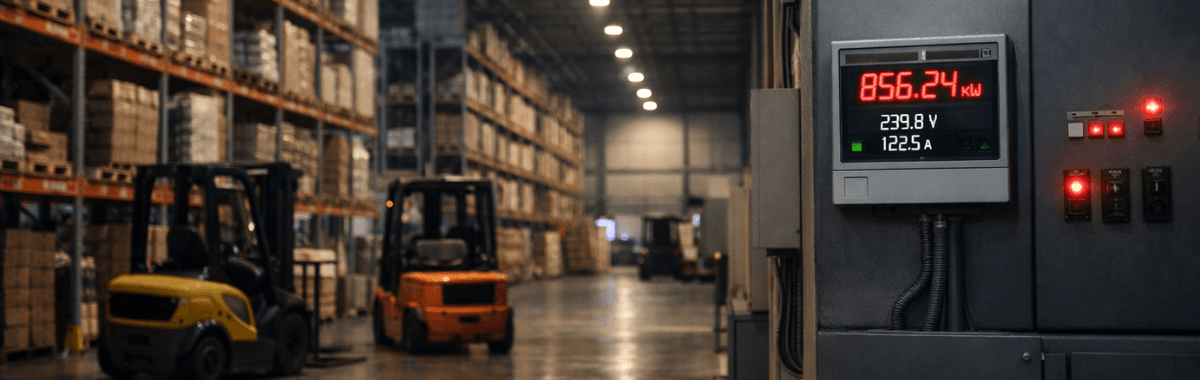
Table of Contents
- The Growing Need for Energy Monitoring in Warehouses
- Key Energy Management Challenges in Modern Warehousing
- Real-Time Visibility and Data Analytics
- Operational Benefits for Warehouse Management
- Integration with Warehouse Automation Systems
- Sustainability and ESG Compliance
- Why Warehouses Must Adopt Smart Energy Monitoring Today?
The Growing Need for Energy Monitoring in Warehouses
Warehouses operate with high electrical loads driven by lighting systems, material handling equipment, HVAC units, refrigeration systems, and automation infrastructure. Without structured monitoring, energy consumption becomes opaque, leading to inflated utility bills and reduced operational efficiency.
As energy tariffs rise and sustainability reporting becomes mandatory, warehouse operators require precise visibility into consumption patterns, peak demand behavior, and equipment-level performance.
Key Energy Management Challenges in Modern Warehousing
Energy waste in warehouses is often invisible until financial losses accumulate. Lack of real-time data prevents facility managers from identifying inefficiencies and abnormal load conditions.
Common Pain Points
- Unmonitored peak demand charges
- Inefficient HVAC and refrigeration cycling
- Idle equipment consuming standby power
- Poor power factor leading to penalties
- Manual meter reading errors
Real-Time Visibility and Data Analytics
Warehouses require granular data to optimize energy usage across zones such as storage areas, loading bays, cold rooms, and administrative blocks.
Live Monitoring Capabilities
Modern dashboards provide real-time tracking of kWh, kVA, voltage, current, frequency, and power factor.
Analytical Intelligence
- Peak load trend analysis
- Equipment-wise consumption comparison
- Historical reporting with export capability
- Energy cost forecasting models
Operational Benefits for Warehouse Management
- Reduction in electricity costs through peak demand control
- Improved equipment life via load balancing
- Automated compliance reporting
- Enhanced sustainability metrics tracking
- Data-backed decision-making for expansion planning
Integration with Warehouse Automation Systems
Energy monitoring systems can integrate with Building Management Systems (BMS), SCADA platforms, and warehouse automation infrastructure to create a unified operational ecosystem.
Seamless System Connectivity
Through standard protocols such as Modbus, MQTT, and REST APIs, energy data becomes interoperable with inventory systems, refrigeration controllers, and safety mechanisms.
This integration enables automated load shedding, predictive maintenance triggers, and synchronized energy optimization strategies across the facility.
Sustainability and ESG Compliance
Warehouses are increasingly evaluated on environmental performance metrics. An energy monitoring solution provides auditable data required for ESG disclosures and carbon footprint calculations.
Environmental Impact Metrics
- Scope 2 emission calculations
- Energy intensity per square foot
- Renewable energy utilization tracking
- Carbon reduction benchmarking
Structured reporting strengthens stakeholder confidence and aligns operations with sustainability goals.
Why Warehouses Must Adopt Smart Energy Monitoring Today?
Warehouses are transitioning toward automation, digitalization, and sustainability-driven operations. Energy monitoring is no longer optional; it is foundational to operational intelligence.
A smart energy monitoring solution transforms electricity from an overhead expense into a controllable operational parameter, delivering measurable financial savings, operational resilience, and long-term sustainability.
Table of Contents
- The Growing Need for Energy Monitoring in Warehouses
- Key Energy Management Challenges in Modern Warehousing
- Real-Time Visibility and Data Analytics
- Operational Benefits for Warehouse Management
- Integration with Warehouse Automation Systems
- Sustainability and ESG Compliance
- Why Warehouses Must Adopt Smart Energy Monitoring Today?
Keep Exploring Our Blog Collection



© 2026, Enthu Technology Solutions India Pvt. Ltd. All Rights Reserved.


